Key takeaways
- Through a Slovenian agency you are employed by the agency and insured in Slovenia (A1), and paid at least under German rules: €13.90 gross per hour in 2026, €14.60 from 2027.
- No law says who pays accommodation and travel; the contract does, and under Article 209 ZDR-1 it must list every benefit for the time abroad and the conditions of your return.
- A room cannot be netted against the German minimum wage; it must meet German standards: at least 8 m² per person, your own bed, a lockable cupboard, no more than eight beds to a room.
- At Evroproces, accommodation on field work in Germany and Austria is provided and paid for by us; travel is arranged, and each vacancy states whether travel costs are covered, as Hettingen's does.
- Before applying, check the MDDSZ register and the AÜG permit, that nobody charges you, and that the A1, pay, accommodation, travel and return are in writing before you leave.
If you take a job in Germany through a Slovenian agency, you remain employed by the agency in Slovenia, you stay insured there, and you are paid at least under German rules. No law decides who pays for your accommodation and travel: your employment contract does, and Article 209 of the Slovenian Employment Relationships Act (ZDR-1) requires that contract to spell out every cash or in-kind benefit for the time abroad and the conditions of your return to Slovenia.
At Evroproces, a licensed agency in Maribor, accommodation on field work in Germany and Austria is provided and paid for by us. Travel is arranged by us; whether travel costs are covered is stated in each job advert, and the current vacancy in Hettingen covers them.
How working in Germany through a Slovenian agency works
Legally this is a posting. The agency signs an employment contract with you under Slovenian law, obtains an A1 certificate from the Slovenian Health Insurance Institute (ZZZS) and posts you to a German client, whose instructions you follow on site. Slovenia's Cross-Border Provision of Services Act (ZČmIS-1) allows only an employer that genuinely operates in Slovenia to post, and requires the A1 application to be filed no later than your first day of work; the ZZZS issues the certificate if you were continuously insured in Slovenia for at least 30 days before the posting.
| Question | Answer when posted through a Slovenian agency | Legal basis |
|---|---|---|
| Who is my employer? | The Slovenian agency; the German company is the client that directs your work | ZČmIS-1 Art. 4; ZDR-1 Art. 208 |
| Where am I insured? | In Slovenia, as the A1 certificate proves | ZČmIS-1 Art. 6 and 8 |
| Under which rules am I paid? | At least German rules: minimum wage €13.90 gross/hour (2026), €14.60 (2027), overtime and leave under German law | AEntG § 2; MiLoV5 § 1 |
| Who pays accommodation and travel? | Whatever the contract says; the law only requires it to be written down | ZDR-1 Art. 209 |
| What standard must the accommodation meet? | German standards, whenever the employer provides it | Directive 2018/957 Art. 3(1)(h); AEntG § 2(1) no. 5; ZČmIS-1 Art. 6 |
If the agency hires you out to the German company as an agency worker (Arbeitnehmerüberlassung in Germany), it needs a German permit under the AÜG on top of its Slovenian register entry. Evroproces holds both: entry no. 111 in the MDDSZ register of labour-provision agencies and an AÜG permit extended to 29 April 2027.
Who pays for accommodation
None of the rules on posting oblige the employer to pay for accommodation. Directive 2018/957 and the Slovenian ZČmIS-1 say something different: when the employer provides accommodation, its conditions must meet the rules of the country you are posted to, so German rules. Whether the employer pays, you pay, or you share the cost is a matter for the contract, which is exactly why ZDR-1 requires a contract for work abroad to list all cash and in-kind benefits.
Two safeguards apply regardless. First, the German minimum wage is paid in money. German customs (Zoll), which enforces it, states that payment in kind is not permitted; the only exception, for board and lodging, covers seasonal workers under the Minimum Wage Act, not the Posted Workers Act (AEntG) and not agency work under the AÜG. An offer that deducts so much for a room that you receive less than €13.90 gross per hour is unlawful. Second, a posting allowance counts as pay unless it reimburses actual travel, board and lodging costs; if the contract does not say which part is reimbursement, the Directive and § 2b AEntG deem the whole allowance reimbursement, so it cannot stand in for the minimum wage.
At Evroproces the answer is short: on field work in Germany and Austria, accommodation near the site is provided and paid for by us. This applies to every offer of field work in Germany or Austria that you receive from us and is written into the advert for the currently open production-worker vacancy in Hettingen.
What accommodation in Germany must look like
The German Workplace Ordinance (ArbStättV, Annex 4.4) requires the employer to provide adequate accommodation whenever shared accommodation was promised at recruitment or posting and the worker would not otherwise have taken the job. The employer remains responsible for its adequacy even when the rooms are rented through a third party. The technical rule ASR A4.4 turns that promise into numbers:
- at least 8 m² of usable floor area per person, of which at least 6 m² of sleeping area when up to six people share a sleeping area; 8.75 and 6.75 m² respectively for seven or eight;
- no more than eight beds to a room in a building and four in container units; bunk beds no more than two high;
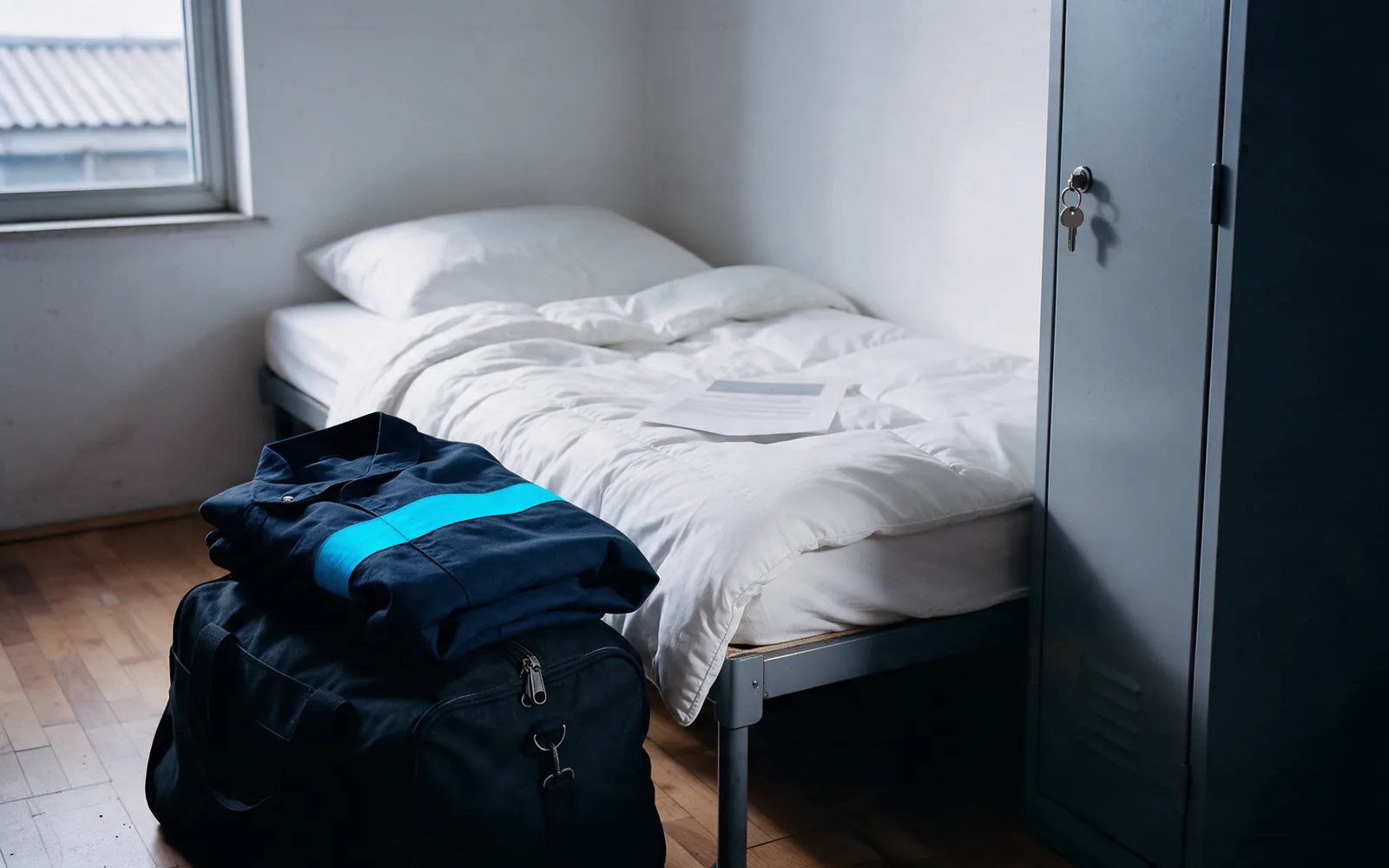
- each resident has their own bed with mattress and pillow, a seat, a table surface and a lockable cupboard for clothes and personal items;
- a dining area and sanitary facilities sized for the occupants; heating to at least 21 °C; daylight; direct access to a public road and reachability for fire and rescue vehicles;
- from day one the employer must keep documentation of shared accommodation at the place of work: addresses, capacity, who is housed where and for how long.
That list is the yardstick for any offer. Before you sign, get it in writing: the address and distance to the site, how many share a room, whether there is a kitchen, laundry and internet, who cleans, the house rules, and what happens to the room on days off or between projects. If the accommodation differs from what was agreed, your coordinator is the first call; at Evroproces every assignment has a coordinator who speaks your language and handles accommodation issues too.
Who pays for travel
Travel is really three different costs, each with its own rule:
- The trip from Slovenia to the site at the start of the posting and back at the end. Slovenian law and your contract govern this. Article 130 ZDR-1 obliges the employer to reimburse business-travel costs, Article 209 requires every benefit for the time abroad to be written down, and Article 208 obliges the employer to ensure your return to Slovenia when the work abroad ends. The Personal Income Tax Act (Article 44) treats reimbursed travel to and from the posting location as tax-free up to government-set amounts, so properly reimbursed travel is not part of your pay.
- Trips home during the posting. No law prescribes them; how often and at whose expense must come from the contract or the advert.
- The daily commute from the accommodation to the site. The German AEntG (§ 2 no. 8) requires travel-cost reimbursement only for journeys within Germany when you must travel to your regular workplace or are sent elsewhere by the employer; for the commute between accommodation and site, ask whether it is organised and who pays for fuel.
At Evroproces, travel is arranged by us. Whether and how far travel costs are covered is stated in each job advert; the Hettingen advert lists them as covered. If an advert says nothing, ask before you apply; the answer belongs in the contract, not in a verbal promise.
What the contract for work abroad must contain
If your contract does not provide for work abroad, Article 208 ZDR-1 requires a new one, which may run for the length of the project. Under Article 209, a contract for temporary work abroad must, on top of the usual terms, contain provisions on:
- the duration of the work abroad;
- public holidays and non-working days;
- minimum annual leave;
- the pay you are entitled to under the rules of the country where you work, and the currency it is paid in;
- additional insurance for health services abroad;
- other cash or in-kind benefits you are entitled to for the time abroad, which is where accommodation and travel belong;
- how rights that the host country regulates differently are guaranteed, at no less than the ZDR-1 level;
- the conditions of your return to Slovenia;
- a link to the single official national website on posting.
For items 4 to 6 the contract may refer to a law, regulation or collective agreement, but the reference must be stated. At Evroproces you receive a written contract in your native language before you travel; it sets out the role, location, duration, pay, working hours and termination terms.
Seven checks before you apply
- The register. A Slovenian agency that hires workers out to clients must be entered in the MDDSZ register of labour-provision agencies. The register is public on podatki.gov.si; look for the register mark, not just the name. Evroproces d.o.o. is mark 111. For hiring out into Germany the agency also needs an AÜG permit; ours is on the documents page.
- You pay nothing. Under Article 165 of the Labour Market Regulation Act (ZUTD) an agency may not charge you anything: no placement fee, no "registration", no deposit. Any request for money is a reason to stop.
- A1 certificate before departure. The employer applies through the SPOT portal, at most 30 days before the start and no later than your first day. Without an A1 you are not lawfully posted; see our guide to the A1 certificate for posted workers.
- Accommodation in writing. Who pays, the address, how many to a room, what happens on days off. Compare it with the ASR A4.4 standard above.
- Travel in writing. The trip there and back, trips home, the daily commute: for each of the three, who organises and who pays.
- Pay in money. A gross hourly rate of at least €13.90 (2027: €14.60), overtime under German rules, a monthly payslip, payment to your own account. A deduction for a room that would push you below the minimum wage is not allowed.
- Return and contact. The conditions of your return to Slovenia are a mandatory part of the contract. You need to know whom to call if something on site or in the accommodation is not as agreed.
At Evroproces you get an answer to each of these points before you commit to anything. In Germany you must also register your address within 14 days; our guide to Anmeldung in Germany explains how. As an EU citizen you need no work permit, as explained in our post on work permits in Germany and Austria.
What applies to work in Austria
The same EU posting rules apply to Austria: you stay employed and insured in Slovenia and are paid at least the Austrian collective-agreement rate for your sector. At Evroproces, accommodation on field work in Austria is provided and paid for exactly as in Germany. The construction figures are in our post on the 2026 Austrian construction minimum wage.
Frequently asked questions
Can the employer deduct accommodation from my pay? You can agree to pay for the room yourself or to share the cost, but it must be written in the contract and the wage you receive in money may not fall below the German minimum wage. At Evroproces, accommodation on field work in Germany and Austria is paid for by us.
How long can a posting last? Under the Posting of Workers Directive, after 12 months all German terms of employment apply to you except the rules on concluding and terminating the contract and supplementary occupational pensions; with a reasoned notification the employer can extend that to 18 months. Our post on extending a posting in Germany explains how.
Who is responsible if the accommodation falls short of the standard? The employer, even when it rents the rooms through a third party (ArbStättV, Annex 4.4). Call your coordinator first. If it is not put right, the Slovenian Labour Inspectorate and the German occupational safety authorities, which supervise accommodation, are the places to turn.
Can I refuse a posting? Yes, for justified reasons under Article 208 ZDR-1: pregnancy, care of a child under seven, single parenthood with a child under 15, disability, health reasons, or other reasons set in the contract or a collective agreement.
Next step
We place candidates who already have the right to work in the EU, EEA, or Switzerland, or who hold a valid Slovenian or Croatian residence-and-work permit. The language level depends on the client's requirements and is stated for each vacancy.
If you are considering work in Germany or Austria, look at the current vacancies or complete the questionnaire on the job search page; we reply within 24 hours, and the process can take up to five working days. Before you sign, we tell you in writing where you will be housed, how travel is arranged and what the contract says. You can also call us on +386 70 630 880.
Sources & further reading
- 01ZDR-1 – Zakon o delovnih razmerjih, NPB 14, 130., 139., 208. in 209. člen (PisRS) (verified 2026-09-22) pisrs.si
- 02ZČmIS-1 – Zakon o čezmejnem izvajanju storitev, 4., 6., 8. in 10. člen (PisRS) (verified 2026-09-22) pisrs.si
- 03ZUTD – Zakon o urejanju trga dela, 163.–166. člen (PisRS) (verified 2026-09-22) pisrs.si
- 04ZDoh-2 – Zakon o dohodnini, 44. člen (1) 4.b (PisRS) (verified 2026-09-22) pisrs.si
- 05Directive (EU) 2018/957 amending Directive 96/71/EC, Article 3(1)(h), 3(1)(i), 3(1a) and 3(7) (EUR-Lex) (verified 2026-09-22) eur-lex.europa.eu
- 06AEntG § 2 Allgemeine Arbeitsbedingungen (gesetze-im-internet.de) (verified 2026-09-22) gesetze-im-internet.de
- 07AEntG § 2b Anrechenbarkeit von Entsendezulagen (gesetze-im-internet.de) (verified 2026-09-22) gesetze-im-internet.de
- 08ArbStättV Anhang Nr. 4.4 Unterkünfte (gesetze-im-internet.de) (verified 2026-09-22) gesetze-im-internet.de
- 09ASR A4.4 Unterkünfte, Technische Regel für Arbeitsstätten, Ausgabe Juni 2010, zuletzt geändert GMBl 2024 S. 914 (BAuA) (verified 2026-09-22) baua.de
- 10MiLoV5 – Fünfte Mindestlohnanpassungsverordnung, § 1: 13,90 € ab 1. 1. 2026, 14,60 € ab 1. 1. 2027 (gesetze-im-internet.de) (verified 2026-09-22) gesetze-im-internet.de
- 11Zoll – Berechnung und Zahlung des Mindestlohns: Sachbezüge nicht anrechenbar (Ausnahme Saisonarbeit nur nach MiLoG) (verified 2026-09-22) zoll.de
- 12MGDŠ – Register domačih pravnih in fizičnih oseb za opravljanje dejavnosti zagotavljanja dela delavcev uporabniku, posodobljeno 10. 9. 2026 (podatki.gov.si) (verified 2026-09-22) podatki.gov.si
- 13Evroproces – Proizvodni delavec, Hettingen, Nemčija: prosto delovno mesto, objavljeno 6. 9. 2026 (verified 2026-09-22) evroproces.com